© Arthur Jafa, Courtesy of the artist and Gladstone
A young girl lays her head on a table and drifts off to sleep while a radio plays in the background. During her long rest, she dreamt of being a lively performer.
But what young person doesn’t have dreams, you might ask? What young person hasn’t dreamed of being a performer at least once? How is this scene any different from what you’d expect from children envisioning what they one day hope to become?
Well, that’s the point.
This young girl in artist and filmmaker Garrett Bradley’s America (2019), a series of twelve short films set between 1915 and 1926, isn’t unlike other young children. What makes her different, though, is that she is a young Black girl — and that changes the calculus of the extent to which society chooses to allow her to dream.
“Freedom Dreams”, which will open to the public on Sunday, April 12th, 2026 at the Barnes Foundation in Philadelphia, asks us to ponder the forms that freedom takes for Black Americans at the 250th anniversary of the nation’s founding. The young child mentioned above is free in her mind to become whatever she wants to be; no one can govern her imagination. When her dreams step outside of the realm of imagination and into the physical sphere is when society’s limitations begin to make themselves known. This is in line with the writings of author and historian Robin D. G. Kelley (from whose book the exhibit takes its name), which expound upon the premise that Black thinkers, activists, and artists have shaped social movements with the power of their collective imaginations.
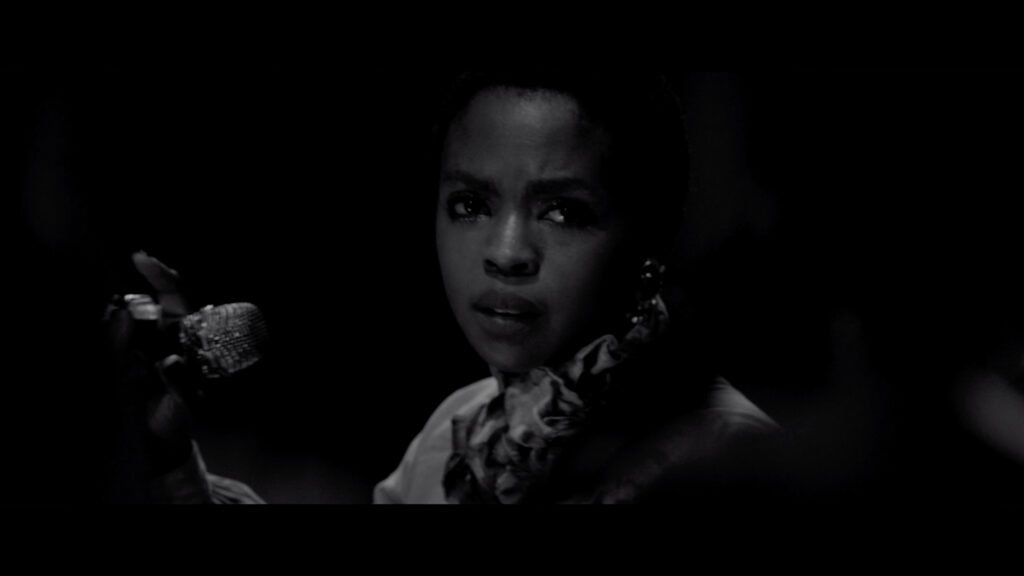
All five of the film, video, and installation works included in “Freedom Dreams” expand upon that premise in their own way. Love is the Message, The Message is Death (2016) constructs a portrait of America as experienced by Black people that is at different times searing and celebratory. Alongside clips of police violence and fires are scenes filled with sports triumphs and dancing, showing that Black Americans have always had to navigate experiencing the highest of highs while being forced to deal with this country’s lowest of lows.
Set to rapper Kanye West’s 2016 gospel-rap track “Ultralight Beam” and consisting of hundreds of images of historical events & social media happenings, artist and filmmaker Arthur Jafa’s work poses this question at one point: “What would America be like if we loved Black people as much as we loved Black culture?”
No one knows the answer to this question, because we’ve never seen anything close to what this would look like.
Artist and educator David Hartt’s On Exactitude in Science (Watts) shows an abandoned Watts, a historically Black neighborhood in South Los Angeles, and the effects that historic events have had on the neighborhood. The video is about the concept of ‘place’, at its core, and the message really hits home when you see homes with boarded-up windows, beauty supply stores, patios, kitchens, and other places where you’d expect to see signs of life — and there’s no one in the frame. Filmmaker Charles Burnett, who influenced Hartt’s choice to make this video, acted as the narrator and gave viewers his memories of his time in Watts. His participation gives On Exactitude in Science (Watts) life, in a video that doesn’t have many other signs of it.
Quiet As It’s Kept (2023) was created by filmmaker and artist Ja’Tovia Gary in response to author Toni Morrison’s The Bluest Eye, a book that Morrison wrote about the legacy of colorism. Gary’s film includes interviews with rapper Lil’ Kim and Toni Morrison scholar Dr. Kokahvah Zauditu-Selassie. In this film, Lil’ Kim quips at one point that “I love what God gave me, but sometimes I wanna dress it up.” Lil’ Kim, for those familiar with her career, was memorably accused of engaging in skin-lightening treatments. I’m not sure if skin-lightening counts as dressing up oneself, but whether or not she actually bleached her skin was her decision.
Another notable point in the film was when a light-skinned actress came onto the screen, crying and apologizing to darker-skinned actresses for “being chosen”. She seemed genuinely sad, remarking that “my mom looks like you” and feeling awful that people who resemble her mom receive so much rejection for the color of their skin. One of the many insidious characteristics of racism is how it creates hierarchy, granting those with closer proximity to whiteness more fortune while placing those without that same proximity at the bottom of the societal pecking order — setting them up for a life of unjustified complication and struggle.
Filmmaker and activist Tourmaline’s Pollinator (2022) pulls together portraits of her father and black-and-white shots of herself wearing flowers and flowy clothing with footage of Black trans activist Marsha P. Johnson’s 1992 funeral. The artist’s choice of flowers was in tribute to Johnson, who loved to decorate herself with florals. Worthy of note is that Tourmaline spent almost 20 years researching Johnson, so with respect to Pollinator — previously included in the Whitney Biennial 2024 — creating an examination of memory, Black transgender freedom, and nature seems like a logical next step for her.
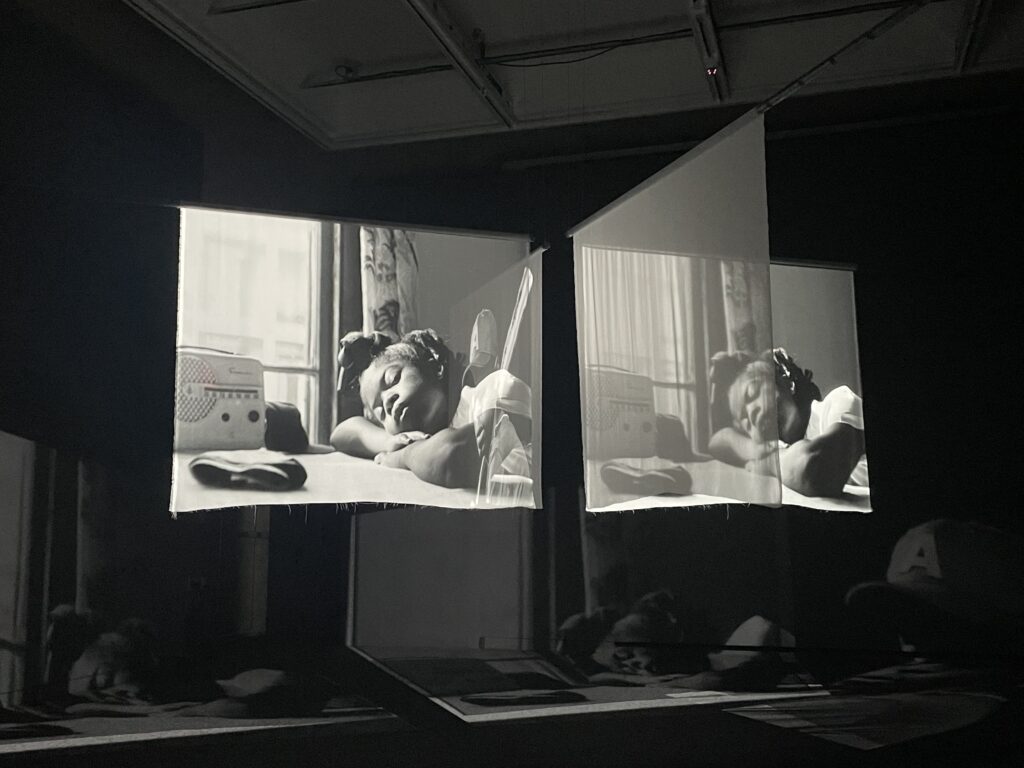
Garrett Bradley’s America, mentioned at the start of this writing, is projected onto white flags and uses archival footage from Lime Kiln Club Field Day (1914), thought to be the oldest surviving film with an all-Black cast. The twelve short films are a montage of Black people playing, dancing, hanging out at the beach, engaging in sports activity, spending time with family, and doing things that any normal person would do. Normality — the ability to just wake up and live — isn’t a luxury typically allowed to Black people by a society polluted with the remnants of white supremacy.
But Black Americans have become particularly adept at two things over the 250 years since the signing of the Declaration of Independence:
1. Surviving an environment which once considered them 3/5ths of a person, and
2. Finding joy wherever one can
Black people have been dreaming for over 250 years of freedom, and it has gotten to the point where changing the definition of what constitutes freedom has become easier than attaining full, inclusive, and national freedom. Make no mistake about it: we have regressed as a society on rights for Black Americans, with legislation like the Civil Rights Act of 1964 and the Voting Rights Act of 1965 having been chipped away at for the past decade and a half.
To return to one of the goals of co-curators James Claiborne, the Fleischner Family Vice President For Engagement at the Barnes Foundation, and Maori Karmael Holmes, the Chief Executive and Artistic Officer of BlackStar Projects, they would like for the exhibition to “invite audiences to reflect on a larger question: what does liberation and freedom look like for Black Americans 250 years after the signing of the Declaration of Independence?”
Audiences passing through “Freedom Dreams” should realize that in the trying times that we are in, we need to engage with the radical imagination and ideas of Black creatives, intellectuals, and activists. But alongside them, we need to not discount the role of radical action in finally achieving that freedom that we have dreamed about for a quarter of a millennium.
“Freedom Dreams” will be open to the public for viewing from April 12, 2026 through August 9, 2026 at the Barnes Foundation in Philadelphia, PA.
To subscribe to Manic Metallic‘s Substack newsletter, click here.