The Philadelphia Art Museum is excited about the shows that it is hosting this year.
It also really wants to leave its messy divorce from Sasha Suda, its former leader, in the rearview mirror and focus on the stellar art for which it is known. This much was evident in a recent interview that Daniel H. Weiss, the new George D. Widener Director and CEO, gave to the Philadelphia Inquirer and in his opening remarks given at the recent press preview for the exhibit. And it was evident when Louis Marchesano (the Marion Boulton “Kippy” Stroud Deputy Director of Curatorial Affairs and Conservation) followed up Weiss’s remarks with a rundown of what lies ahead this year for the museum’s show schedule.
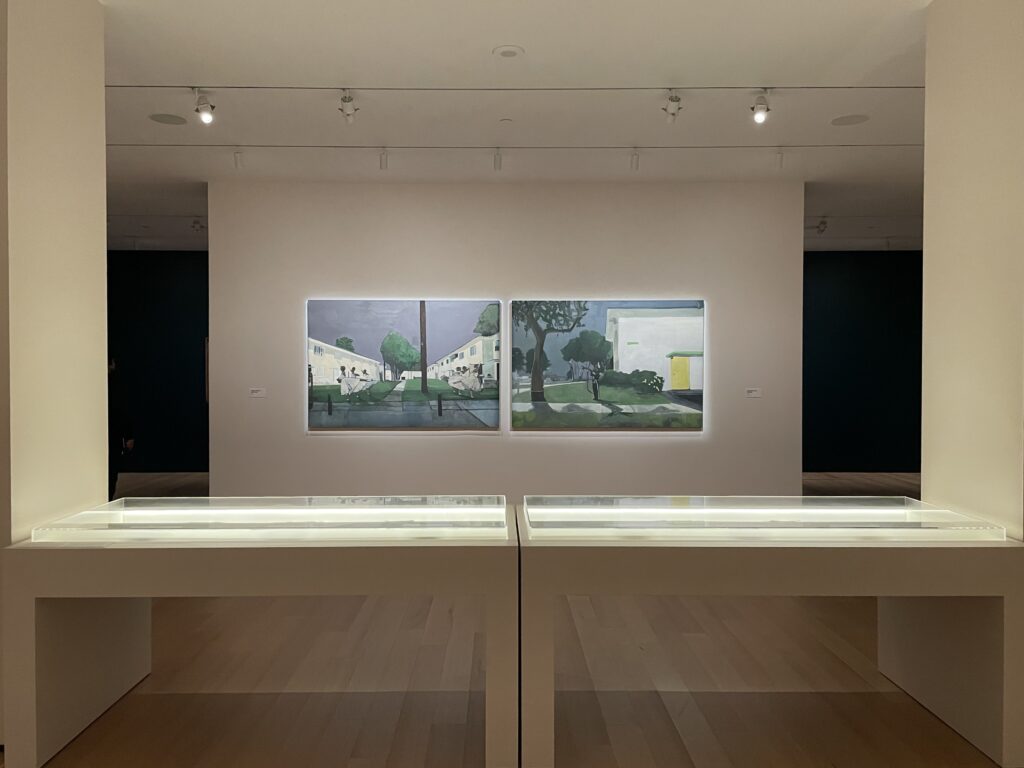
The opening of “Noah Davis” is a good way to shift gears towards the exhibition lineup that the institution, which is celebrating its 150th anniversary this year, has planned for 2026. This exhibit is a celebration of Seattle native Noah Davis’s life’s work as an artist, containing over 60 works that span sculpture, painting, curation, and works on paper and stretching from topics like politics and race to mythology and visual culture. Curated by Eleanor Nairne, the museum’s Keith L. and Katherine Sachs Curator and Head of Modern and Contemporary Art, and Wells Fray-Smith, Curator at the Barbican Centre in London, “Noah Davis” features work that he created from 2007 up until the artist’s untimely passing in 2015. This is the last stop for the exhibition, which was organized by the Barbican in London and made additional stops in Potsdam, Germany and Los Angeles, California.
The exhibit begins with an opening wall filled with photos of Noah’s work and of him engaging in the act of creation and spending time with his family. A video plays on loop that includes an interview with Noah in which he responds to a question by the interviewer about his motivation for being a painter by saying that “I just couldn’t do anything else. I’d rather suck at painting than be successful at anything else.” He was stating this from the standpoint of not (in his mind) having the ability do anything other than painting, having tried other things. But he was actually devoted to painting from a young age, with his parents having rented a studio for him as a teen. Many a creative truly devoted to their craft knows the feeling of having a sense of alienation from any field other than that in which you create.
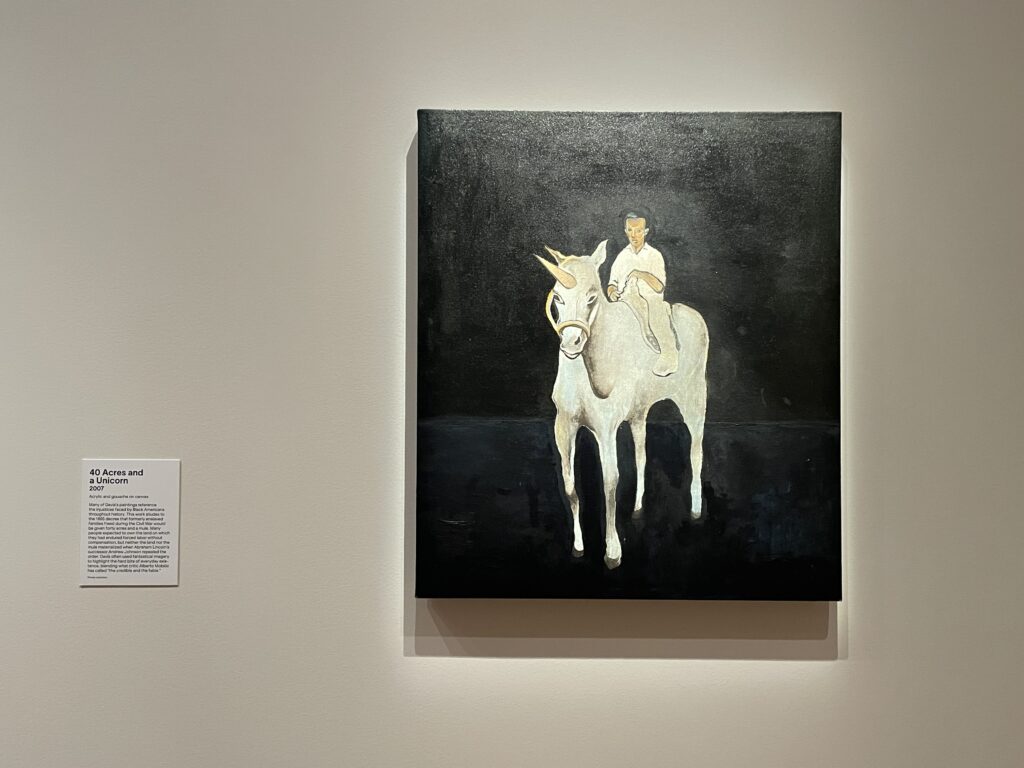
You’ll see some of Noah’s earlier work when you enter the first gallery, among them “40 Acres and a Unicorn” (pictured above). This reference is well-known by anyone familiar with American Civil War history as a broken promise by the United States government to give every formerly enslaved family forty acres and a mule as reparations. This order made by President Abraham Lincoln was swiftly repealed upon Lincoln’s assassination by Lincoln’s successor Andrew Johnson, who was viewed by many as stymying the progress of Reconstruction. The unicorn as a stand-in for a mule in this painting could be seen as representative of a commitment that was not likely to have materialized, whether or not Johnson was the sitting president in charge of carrying out the order. Unicorns are fictional creatures, just as the promise of reparations for Black Americans has proven to be.
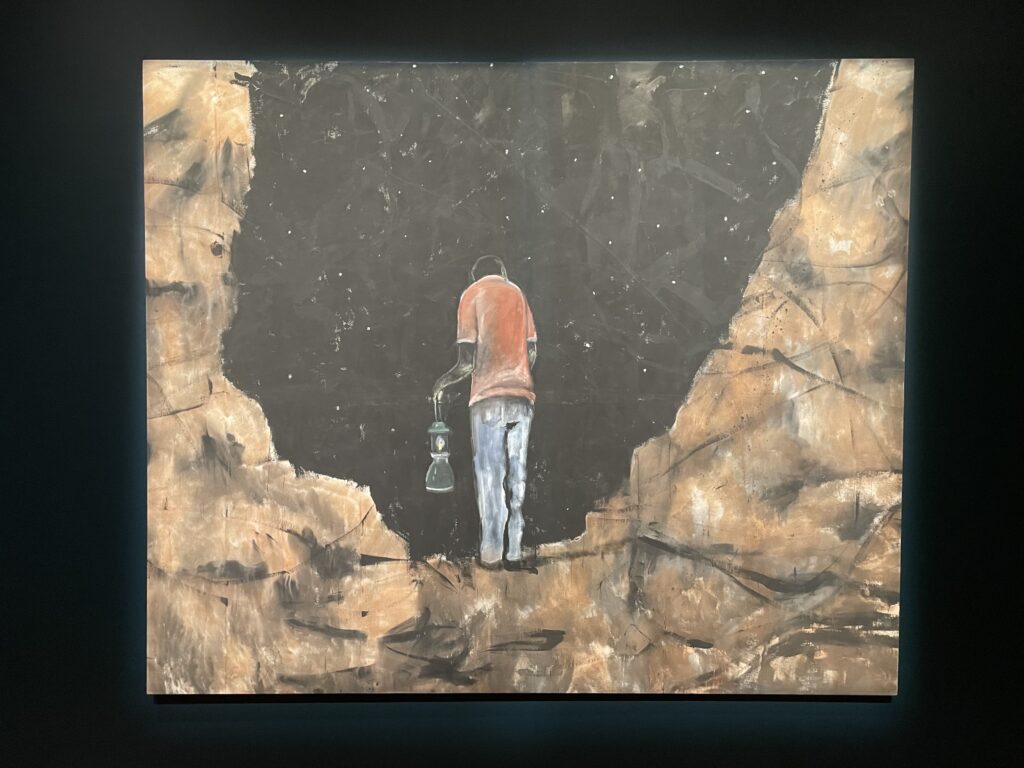
Davis’s interest in the mythic carried through to his interest in Ancient Egypt. He saw he and his wife Karon as Osiris and Isis, the god of the afterlife and the goddess of fertility and magic, respectively. You’ll see in “Painting for My Dad”, which was painted around the time that his dad was diagnosed with terminal cancer and after he himself had just become a father, this marriage to the mystical as a lone figure stands on the edge of a cliff staring into a dark abyss. The afterlife, despite many artistic depictions by humans throughout history, remains a mystery to us mere mortals, and we are left pondering our fate as we stand on the edge of time not knowing if this is where we fully part with existence or merge with some unknown spiritual field.
Many of us have known someone who has ultimately succumbed to an incurable illness, and the figure in Noah’s work here embodies that uncertainty of both the person suffering the illness and the loved ones who will be left behind. The experience captured here for both parties mentioned above is reminiscent of a line from the song by Canadian band Metric, whose work was coming to prominence during Davis’s heyday as an artist:
“We’re so close to something better left unknown / I can feel it in my bones.”
We are forced into accepting the unknown — to embracing the void — whether we like it or not.
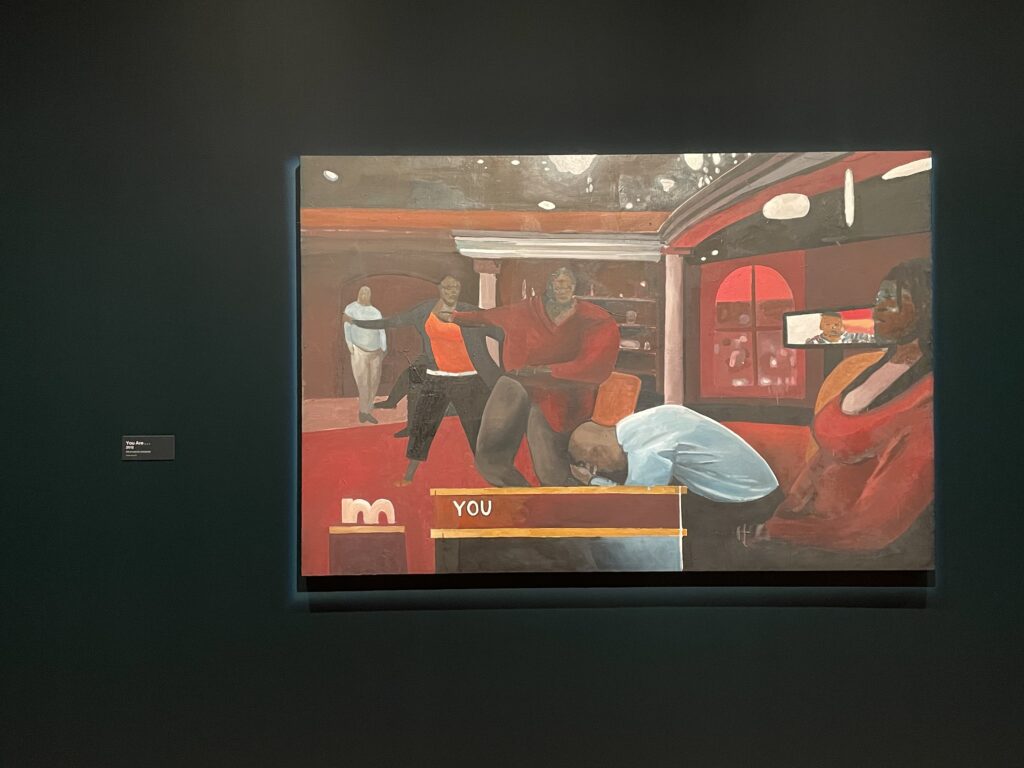
Davis was plugged into visual culture, both online and offline. In 2012, he created Savage Wilds, a series in which he took on daytime television’s portrayal of Black people. A few of these works were based on freeze frames of Maury, the infamous show hosted by Maury Povich that thrived on dysfunctional interpersonal dynamics between the show’s guests. In “You Are…”, a Black man hangs his head in his hands while two women tower over him and another sits sternly beside him. The two standing figures almost seem to be doing a coordinated dance as they triumph in a decision which has presumably been made in their favor and against the male participant.
Make no mistake about it, though: everyone in this painting is experiencing different shades of pain, as they would have been in the real show — and it is all being widely broadcast for the entertainment of the viewing public. The tendency for American society to take enjoyment in — and to profit from — Black pain has a sinister history dating back to the country’s founding, and this television show that Davis portrays here checks the same box. Maury was a notorious presence in 1990s television culture, as anyone alive during that time can tell you, serving as background noise in many a home and feeding a society that had a vampiric hunger for cathartic experiencing of the misery of others. What Davis captures in “You Are…” and the other Maury paintings is a parasitic cultural tendency that has always been present, but was amplified by late 20th century pop culture and has not abated since.
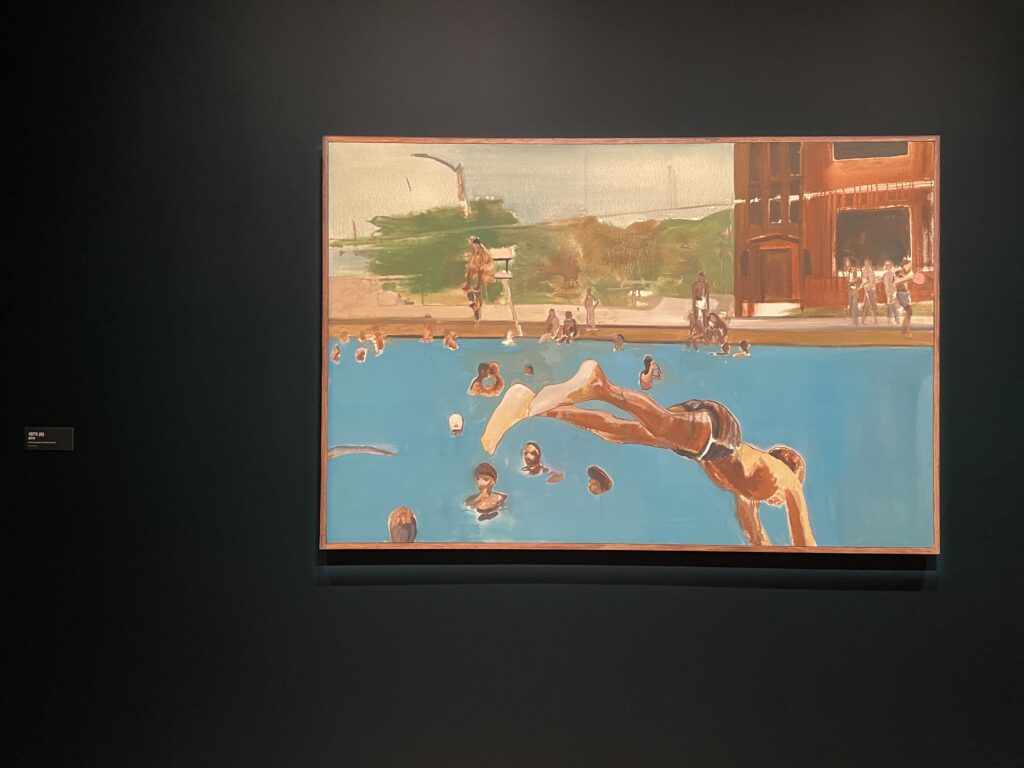
Noah Davis’s work depicted Black happiness as much as it portrayed Black misery, showing the complexity of the Black experience in America. In the 1975 painting series, he took inspiration from some of his mother’s vintage photographs and painted visions of Black kids swimming in pools and hanging out in the city like other youth, as in “1975 (8)” (above). And this painting seems placid enough unless you are aware of the contentious history between Black people and swimming in the United States and the part that such a simple act played in the 20th century push for basic respect and dignity for Black people. So to see “1975 (8)“ displayed so prominently and respected so widely is itself an audible triumph for Black joy.
And in the Pueblo del Rio series, Noah Davis reimagines the Los Angeles housing project of the same name — partly designed by architect Paul Williams for Black defense workers as a “garden city” emphasizing shared community but quickly devolving into a dangerous place — as a place of delight and refuge instead of an unsuccessful design that started with the best of intentions. After all, most desires for a better future start with someone (or many people) fantasizing about how to get there and what that better future would look like.
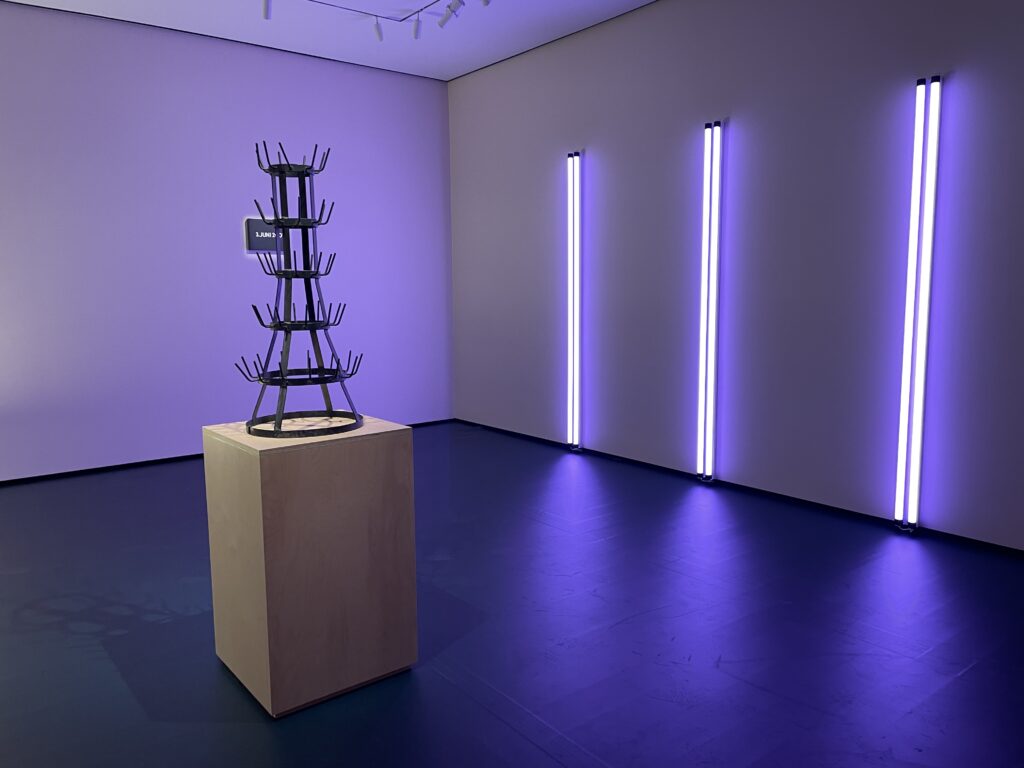
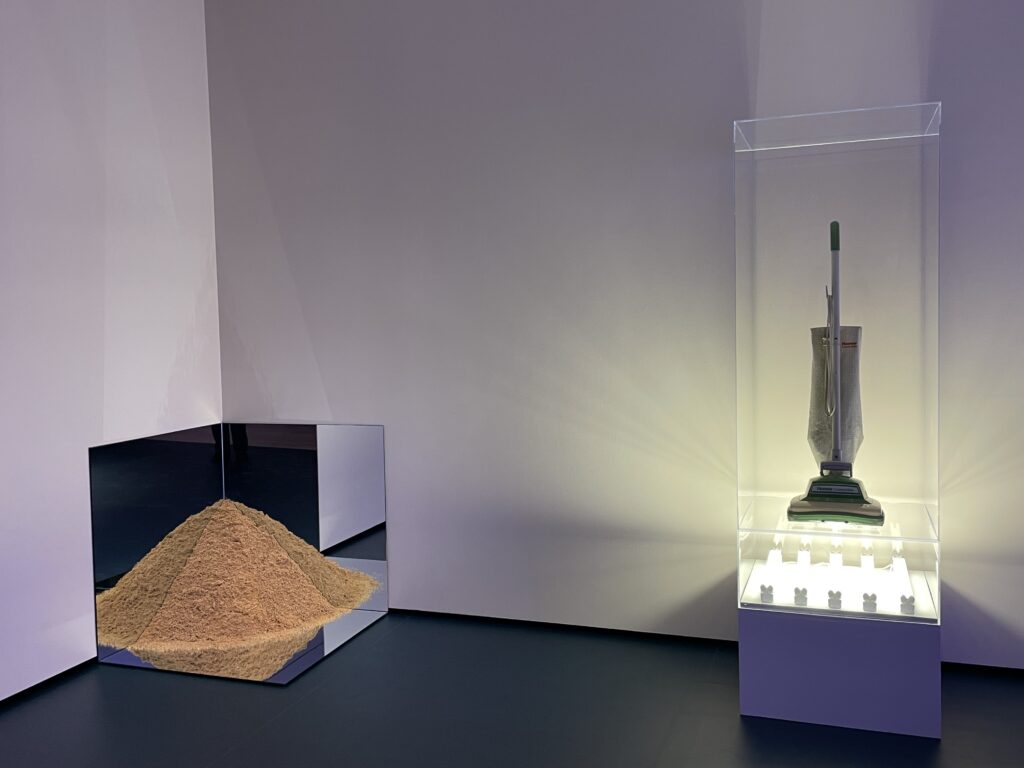
The Missing Link section, towards the end of the exhibit, has an interesting story behind it. Davis and his wife Karon started the Underground Museum in Los Angeles with a small inheritance from Davis’s father, and were getting ready to host their first exhibition when they found that their requests for loans from other museums kept getting denied. Disappointed but motivated, Davis decided to create imitations (or bootlegs, or dupes, depending on what generation that you originate from) of works from Jeff Koons, Marcel Duchamp, Robert Smithson, and Dan Flavin. You can see those works from the 2013 exhibition above; the imitations have morphed into their own respected artworks. That desire to not let the reluctance of other museums to collaborate with them stop the joy that he and his wife wanted to bring to their neighborhood is a testament to the pursuit of artistic excellence.
As you finish up the exhibit and exit, you realize that everything that you’ve just seen was created by someone who was only 32 when he passed away. All of the creative excellence to which you’ve just bore witness was compiled by Noah Davis in less than a decade. Not many people can say that they’ve had the courage to do that much in decades more than Noah was given on this planet. His talent burned bright, and the sadness that fills you as you view the assemblage of visuals of him creating and spending time with family one last time is immense.
One wonders if Noah is somewhere out there assuming his mantle as Osiris and shepherding others safely into the afterlife.
“Noah Davis” will be open to the public for viewing from January 24, 2026 through April 26, 2026 at the Philadelphia Art Museum in Philadelphia, PA.
To subscribe to Manic Metallic‘s Substack newsletter, click here.