Artwork by Alexander Calder © 2025 Calder Foundation, New York / Artists Rights Society (ARS), New York.
Almost four months after the opening of Philadelphia’s Calder Gardens to the general public, you can still observe the excitement and curiosity from patrons about the much-hyped artistic space (the institution prefers to not be called a museum).
It lives up to the high praise that it has received.
Philadelphians have been anticipating the arrival of Calder Gardens for years now, but it is no surprise that the completion of the project drew out; that has a tendency of happening with large-scale projects that are focused on arts and culture.
The intent of the project was to create a cohesive relationship between art, nature, and architecture that would honor the work of Philadelphia-born artist Alexander Calder and give visitors a place for contemplation and reflection. One way that this intent is promoted inside the space is the lack of placards with information on the artist and the artwork on display. While some attendees might find this aspect unusual, one need only take a short trip across Benjamin Franklin Parkway to the Barnes Foundation (which has formed a collaboration with Calder Gardens to provide administrative and operational support for the institution) to see an example of this practice being done successfully.
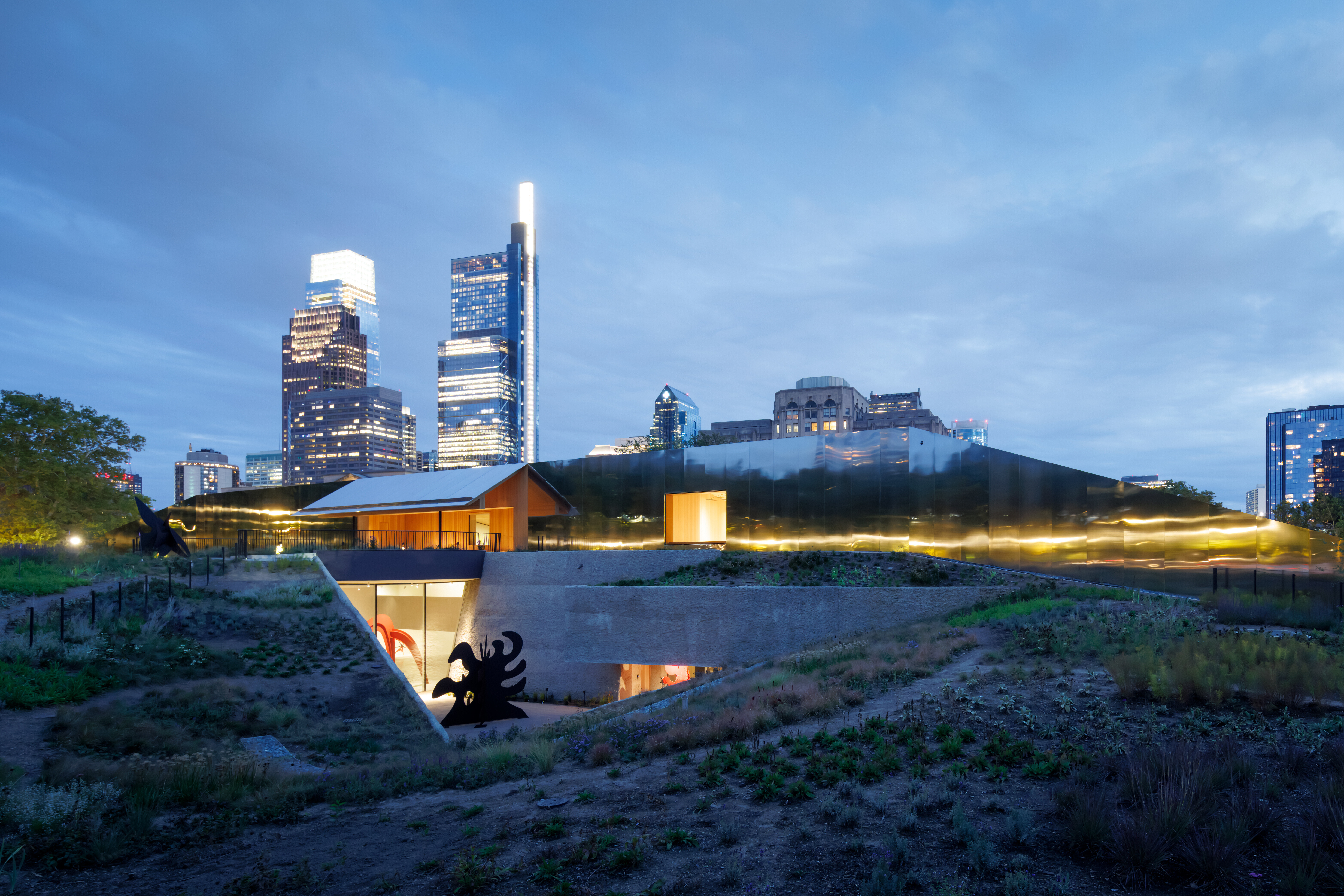
How this joining of art, nature, and architecture works for the outside of the building is something that can be more accurately judged when the gardens grow in. The various outdoor gardens and paths are free and open to the public to enjoy which, while the winter doesn’t offer much to see in the way of plants, still allows both visitors and those passing through to admire the building’s architectural design — created by the Pritzker Prize-winning firm Herzog & de Meuron.
With Calder Gardens, the Swiss design practice brought a jolt of cutting-edge modern architecture to a city that doesn’t get nearly enough of it.

When you are walking up the path toward the museum’s entrance, you’re made aware of the visual contrast of the reflective surface sitting alongside the different shades of wood on various parts of the exterior. It gives the facade the feel of a barn steeped in high design principles.
Much of the interior space is below street level, which is partly for reasons given to practicality; the Calder Foundation had 1.8 acres of land to work with to create this project. The designers make use of high ceilings and well-placed vertical lines to enhance the sense of overall space.
To enter the galleries, you descend steps leading down from the lobby which can serve as seating. As Calder Gardens aims to be an artistic community space for Philadelphians and intends to host a variety of programming to support this goal, these steps can also serve as a small auditorium.
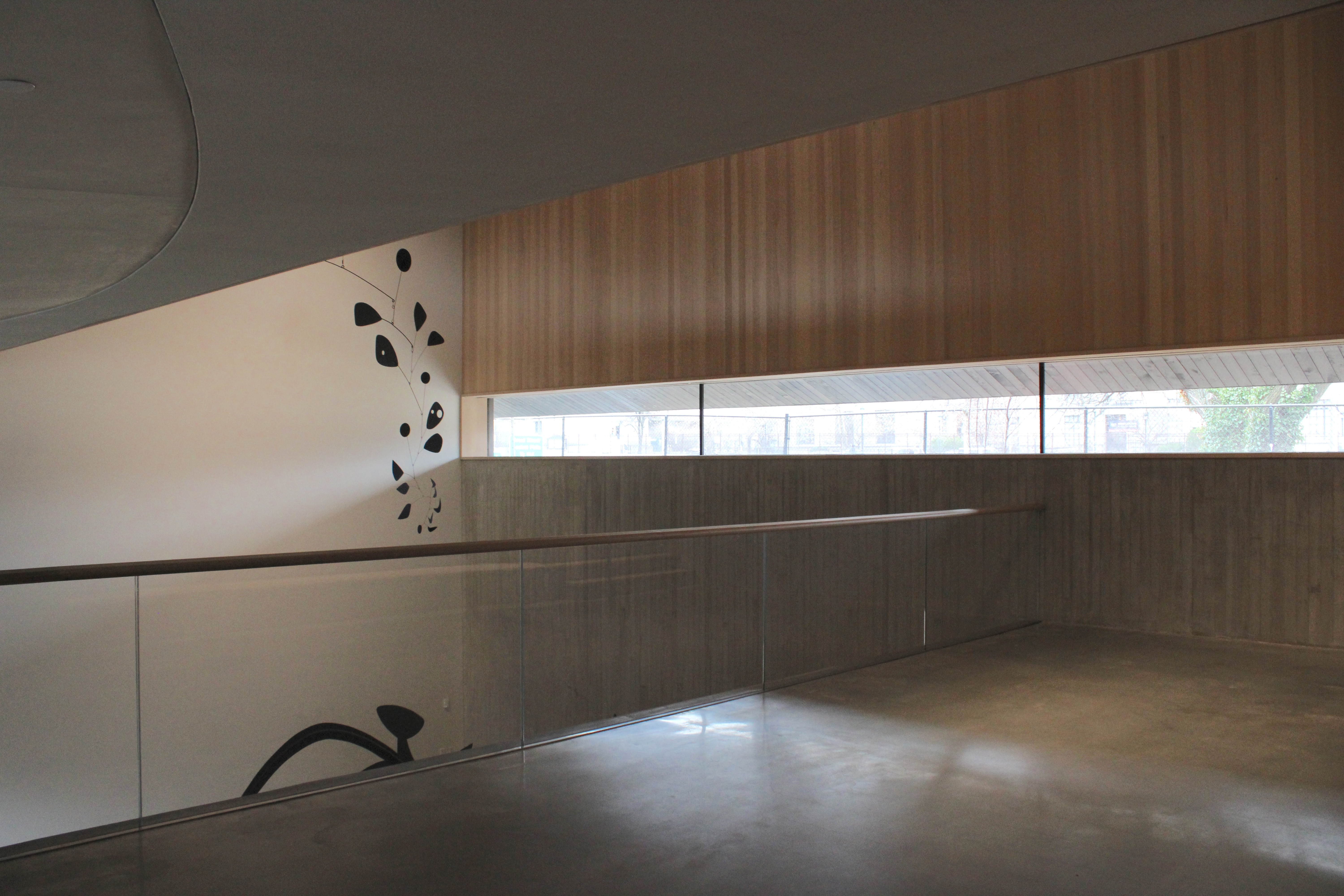
Those steps lead you to the Highway Gallery mezzanine, which is aptly named because it contains a long, linear window that gives visitors a scenic view of the passing traffic on I-676. The window serves as a creative entry for natural light into the space, and adds visual interest.
You’ll also come face-to-face with Black Widow (1948) hanging from the ceiling of the Tall Gallery, located below the mezzanine. Visitors have an opportunity to get a peak at works in both the Tall Gallery and the Open Plan Gallery before descending the staircase that will lead them to the primary gallery spaces.
This cave-like descent — black concrete on the walls and low lighting included — into the main galleries hosts a window displaying Tentacles (1947), a lone, slowly-moving delicate mobile on which it’s easy to become transfixed. But the trick here is that you have to stop and watch it. That’s where the magic happens. You’ll find that this is the case as you travel through the rest of the galleries.
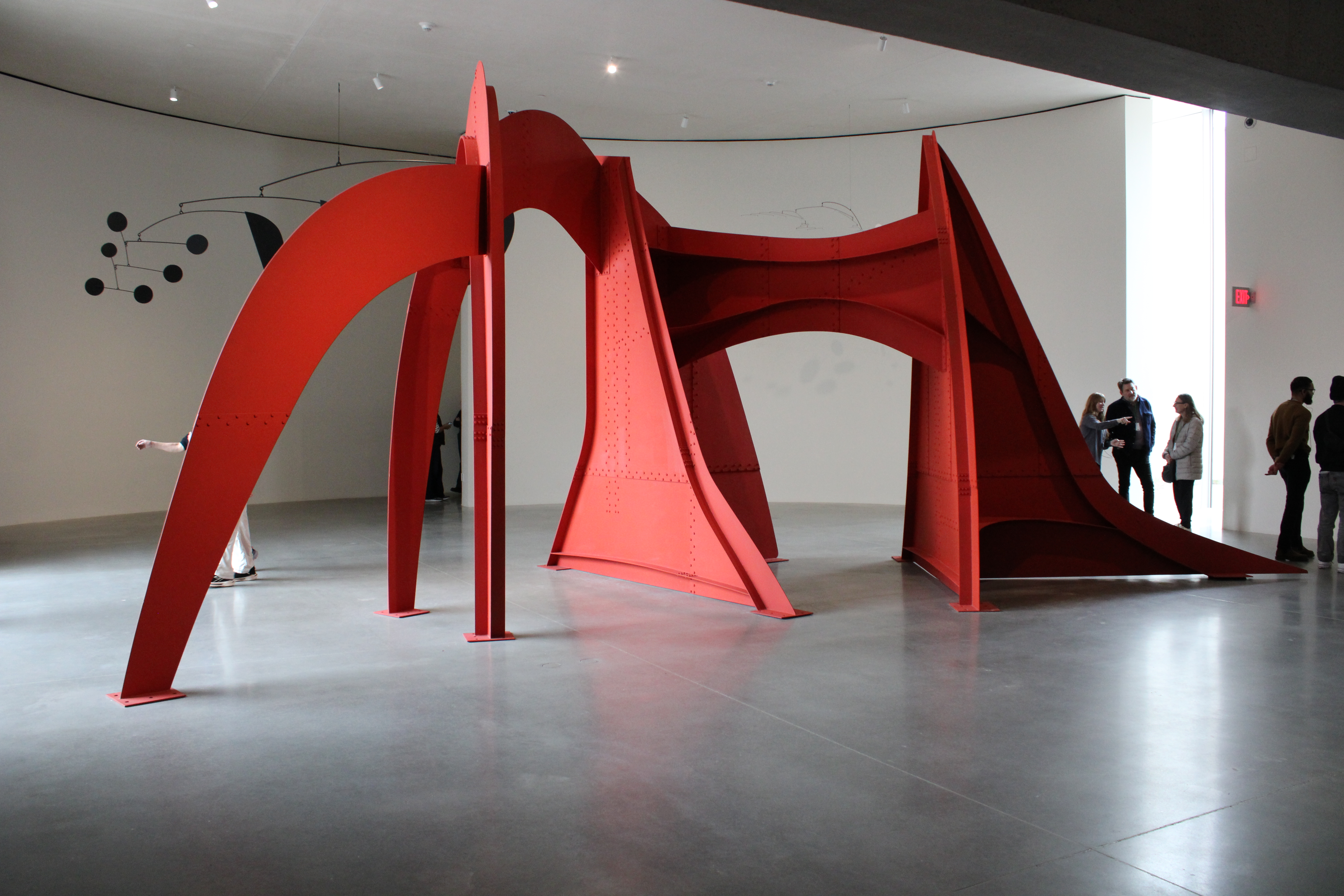
Once you enter the main galleries, you’re met with spacious areas containing large sculptures, mobiles, stabiles, and paintings. To your left, you’re met with the Open Plan Gallery and the monolithic Jerusalem Stabile II (1976). As with many of the larger works, there is plenty of room to walk around and through it to experience it from different vantage points.
Visitors looking for a place to sit and ponder the works on display will find no shortage of places to do so. Periodically, you’ll find benches as well as a couple of opportune spaces carved out of the walls to serve as seating.
One place that you’ll find this wall-carved seating is in the Apse Gallery, just around the corner from the Open Plan Gallery. On padded seating, you are free to sit and ponder Eucalyptus (1940), a tall, black — but no less delicate — hanging mobile dangling in a space with light shining down from above, nothing else having been placed in its vicinity. Time could pass quickly here and one wouldn’t know it because it holds your attention. Because Calder’s mobiles move so incrementally — like wisps of hair gently blowing in the wind — the viewer is asked to slow down and appreciate what is in front of them. Everything else — any obligations, any worries, any stresses — can be tended to at a later time. The current moment requires your presence.
This is consistent with the feeling that the team at the Calder Foundation wants to evoke in attendees, evident in this quote from Alexander S. C. Rower, President of the Calder Foundation and grandson of Alexander Calder:
“Walking through Piet Oudolf’s gardens and into Jacques Herzog’s building, your breathing deepens and your heart rate slows. The choreography of the building invites contemplation of single works of art. When you sit down on a bench, you are able to be still with an object—perhaps eliciting a personal transformation.”
Emerging back out of this tiny space of tranquility and crossing the main gallery area will lead you to the Tall Gallery (to your left) and the Low Gallery (to your right). The Tall Gallery, if you’ll recall, was able to be seen from the above mezzanine.
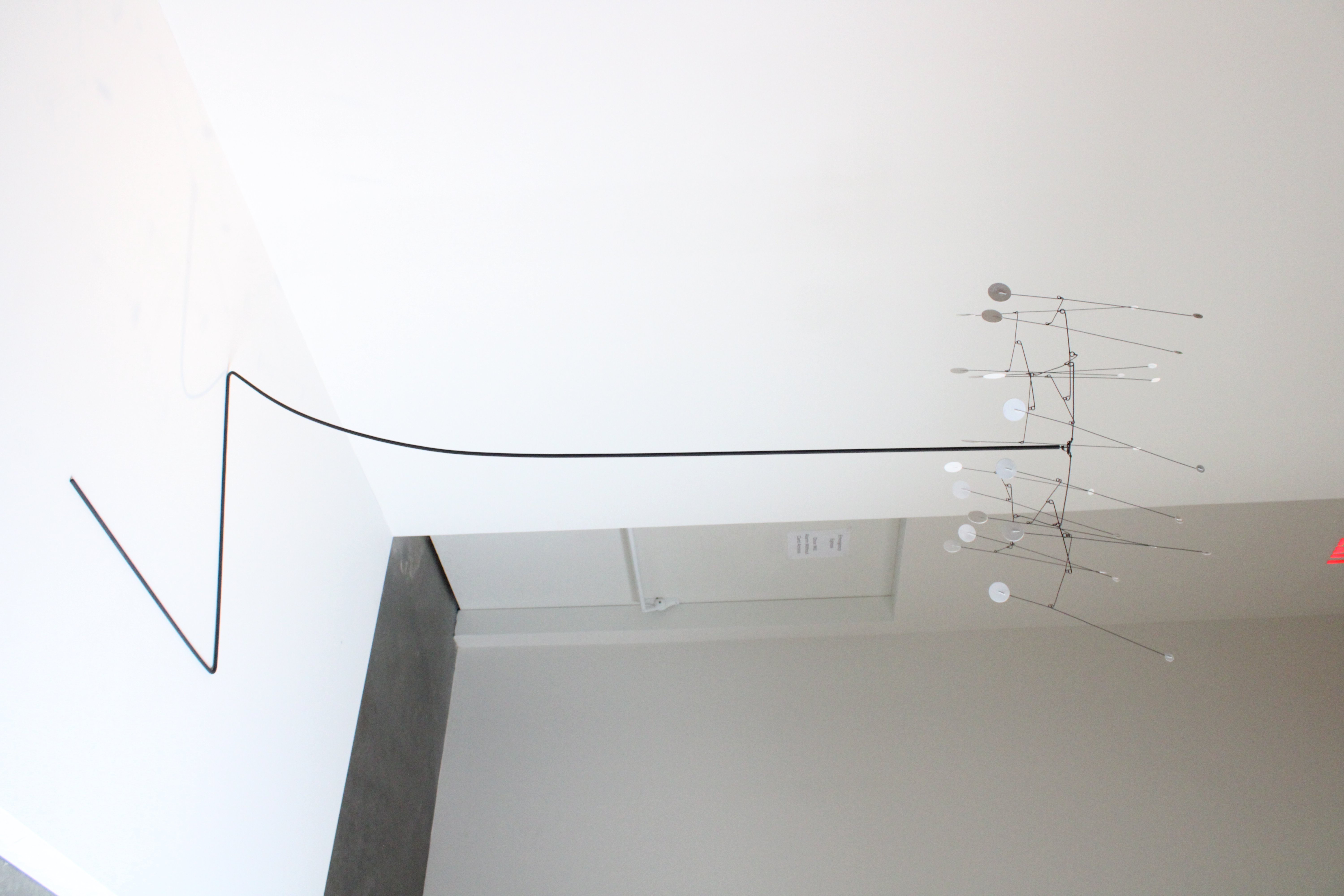
On your way into the Curve Gallery, you’ll spot a standing mobile, Untitled (1954), through the window; the wall behind the mobile will eventually be home to plants. One of the showpieces in the Curve Gallery is Thirty-Two Discs (1951), a standing mobile that is somehow reminiscent of an eclectic lamp.
Following the curve around to the other side envelops you in wood on one side and concrete on the other. It makes for a raw, grounded experience, and it gives the artworks hanging on the wall a more compelling location to be instead of the white walled canvas experience typical in many modern museums.
The Curve Gallery drops you into the Small Gallery — a purple painted room that serves as a place to pay homage to members of Alexander Calder’s family lineage who were also artists. One of these works will be very familiar to Philadelphians — a scaled down version of the William Penn statue, created by Calder’s grandfather Alexander Milne Calder and which sits atop Philadelphia’s City Hall.
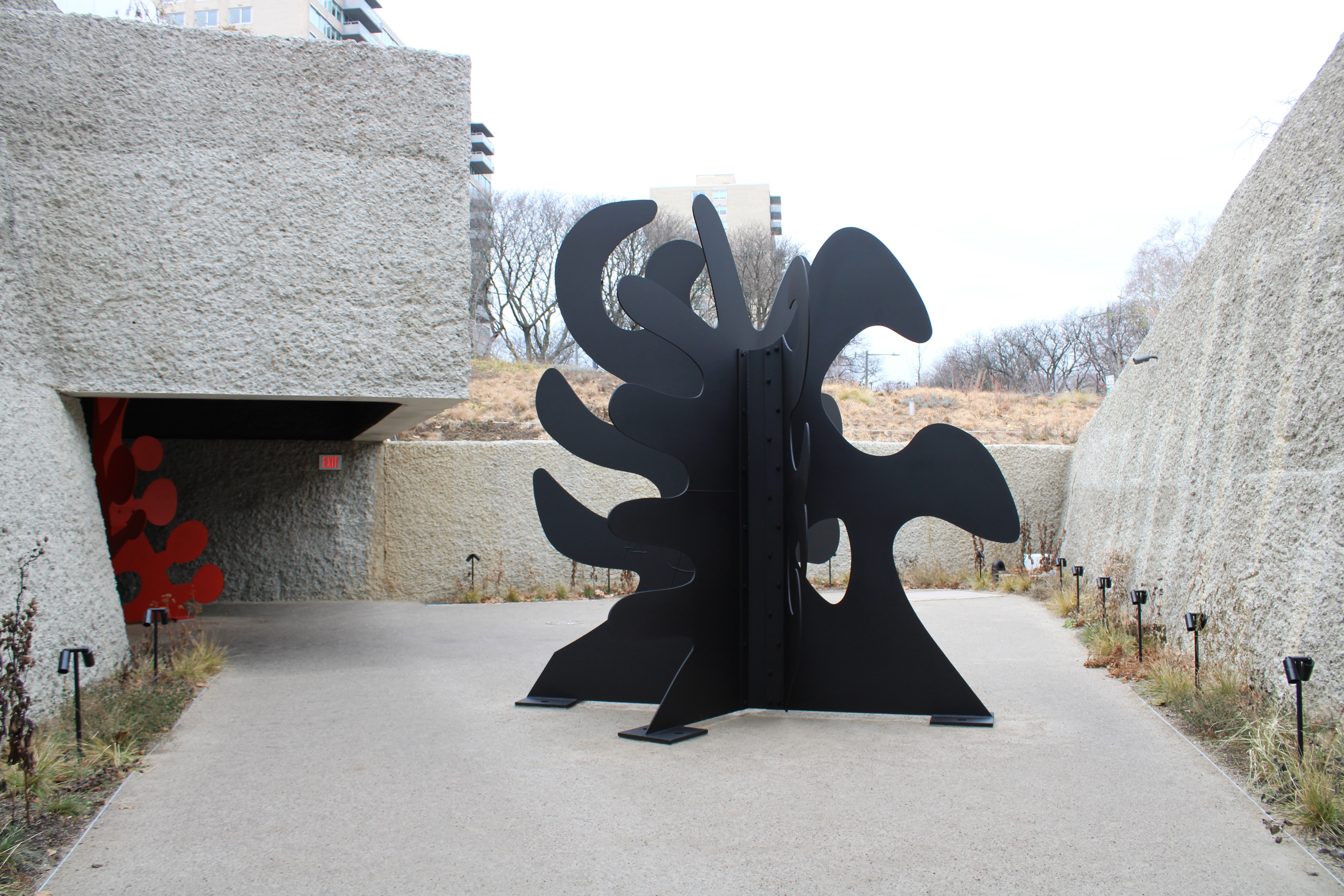
Go outside, and you enter into a pocket that includes two separate spaces holding two large stabiles. Stationed in the Quasi Gallery is Knobs (1976) while the Vestige Garden displays Tripes (1974). and what should be beautiful landscaping once spring arrives. While outside, you are reminded that Calder Gardens exists within an “urban void”, as the project’s architects termed it, by the unobtrusive but persistent sounds of traffic not too far away.
They admit as much in the architectural statement:
“Despite its central location, the site is a leftover space without much obvious charm. The sound of the highway is always present, and few people have had reason to walk through the site.”
In the end, Herzog & de Meuron embraced the location’s limitations — partly out of necessity — and their design adapted to the environment rather than attempt to turn the physical area into something that it is not. Calder Gardens is in an area with lots of traffic and highways, and Philadelphia was consequently given a jewel of a design to break up the monotony of the area next to the intersection of I-676 and Benjamin Franklin Parkway. The seven garden spaces designed by Piet Oudolf, the Dutch landscape designer of New York’s High Line and Chicago’s Lurie Garden in Millennium Park, will also go a long way to creating more of a sense of calm and repose once the more than 250 plant varieties have come fully into bloom in the approaching seasons.
But it should be noted that the landscape is compelling to see in all seasons despite a lack of greenery in the winter months. As a case in point, I remember being told by a patron how the area looked during a recent snowfall. As I stood and stared out the large window in the lobby at Oudolf’s gardens, thinking of the possibilities of beauty between the trees lining Benjamin Franklin Parkway & the Calder Gardens property and remarking on how beautiful that spring and summer will be, the patron replied, “It was mesmerizing during the recent snowstorm.” The security guard commented in agreement.
I responded back to them, “I can only imagine.”
Calder Gardens, located at 2100 Benjamin Franklin Parkway in Philadelphia, is open Thursday – Monday from 11am-5pm.
To subscribe to Manic Metallic‘s Substack newsletter, click here.